Product Manager Case Study Interview: A Full Worked Example (Netflix)

Picture this. You are a Product Manager at Netflix. You have barely settled into your chair when the interviewer slides one sentence across the table: “For the past few weeks, your average weekly watch time has been going down. How would you approach this problem?”

That is it. No data, no context, no hint. Just you, a blank page, and a ticking clock.

This is the case study round, and in my experience it is where most Product Manager offers are quietly won or lost. You can have a great resume and a warm chat in the first ten minutes, but this is the round where the interviewer finds out whether you actually think like a PM. So let’s solve one together, end to end — the exact Netflix “drop in watch time” case I walked through in this mock interview.

Why the case study round decides your PM interview

A case study is not a quiz with a right answer at the back of the book. It is a conversation. The interviewer is not sitting there waiting for you to magically name the one bug that broke watch time — they are watching how you get there.

Can you take a vague, scary, open-ended problem and break it into pieces? Do you reason out loud so they can follow your thinking? Do you know when to ask for data and when to make a call? That is the job. The interview is just a compressed, slightly terrifying version of a normal Tuesday.

So the goal is not to be right. The goal is to be followable.

The mistake most candidates make in the first two minutes

Here is what I see go wrong more than anything else in the mock interviews I run: the moment the candidate hears “watch time is dropping,” their brain sprints to solutions. “Let’s send a re-engagement email! Let’s improve recommendations! Let’s add more content!”

Please don’t. You have diagnosed nothing. You are prescribing medicine before you have asked where it hurts.

A strong candidate does the opposite. They slow down. They treat the first few minutes as detective work, not firefighting. Watch how the whole case below is basically one long, patient narrowing-down — and how the actual solutions only show up right at the end, once we know exactly what we are fixing.

Step 1: Clarify the problem before you touch it

Before anything else, make sure you and the interviewer are solving the same problem.

I started by pinning down the metric itself: watch time, for me, is the total number of minutes of content watched across all users, including rewatches, across all devices and geographies. The interviewer agreed and added a useful constraint — keep it at a weekly level to avoid daily noise. Good. Now “watch time” means the same thing to both of us.

Then I scoped it: is this drop global, or a specific market? The interviewer narrowed it to India only.

Notice that these are not throwaway questions. Defining the metric and scoping the market took thirty seconds and instantly made the problem smaller and sharper. That is the whole game — turning one giant fuzzy problem into a series of smaller, answerable ones.

Step 2: Split the funnel into “internal vs external”

Now the detective work. Before proposing anything, I need the root cause, and for that I need data.

I asked for three things: is the drop on a specific platform (app vs web), how many users are logging in, and what is the average watch time per user? The answers did most of the narrowing for me:

  • The drop is across all platforms — so it is not a broken app build.
  • The number of users is stable — same traffic, roughly the same split of new versus returning.
  • But average watch time per user is down about 10%.

Sit with that for a second, because it is the hinge of the entire case. Same number of people are showing up, but each one is watching less. That single fact tells me the problem is almost certainly internal — something about the content or user behaviour — not external.

Now, here is a habit that separates strong candidates from average ones: I still listed the external factors before discarding them. Could it be a competitor launch? A change in our marketing? A cricket World Cup stealing everyone’s evenings? I said each one out loud, explained why the stable user base makes it unlikely, and only then set them aside.

Why bother, if I was going to reject them anyway? Because if you silently skip a factor, the interviewer can’t tell whether you rejected it on purpose or never thought of it at all. Say it, reason about it, discard it. Out loud.

Step 3: Follow the trail to the real culprit

With external factors parked, I went hunting inside. Two suspects: content and user behaviour.

I started with content. Did we pull anything off the platform? Is the drop in regional or international content? Any particular genre? The interviewer’s answers kept sharpening the picture: roughly 70% of what India watches is regional — mostly Hindi — and the majority of the drop is coming from that Indian content, with no genre pattern. Supply and quality of that content, they told me, are fine.

So the story now reads: same users, watching less Indian content, and nothing wrong with the content itself. That points squarely at user behaviour.

I probed the obvious behavioural lever first — did the search or recommendation algorithm change? No. Then I asked whether it was tied to a content type, and got a gift of a clue: a higher drop in movies, especially old movies. Stitch it together and the problem has a face now — it is users who used to watch old Hindi movies.

But I still needed to know how those users used to reach that content. So I listed behavioural patterns and asked the interviewer to point me in the right direction: time of day, online versus offline downloads, and how they discovered content — home-page thumbnails, notifications, or search. Timing was too volatile to matter. Online/offline hadn’t shifted. But search? A significant chunk of the drop was coming from users who used to search for content and watch it.

We have now travelled from “watch time is dropping globally” all the way to a single sentence: users who used to find old Hindi movies by searching for them are watching less. That is the power of narrowing before solving.

Step 4: Break the journey into a funnel, then find the break

When the drop is tied to search, walk the search journey as a funnel. There are only a few places it can break:

  1. Users aren’t clicking the search icon at all.
  2. Users click search, but don’t actually type anything.
  3. Users search, but the results disappoint them, so they drop off.

I flagged that number three points at the search algorithm — which the interviewer had already ruled out. That left one and two, and sure enough, both were down: fewer people clicking search, and fewer people typing a query after clicking.

So I asked the obvious follow-up: did the search experience change recently? It had. Two changes, in fact. The search icon had moved from the bottom nav bar to the top right, and the search page now surfaced more recommendations, including Games.

There it is. Not a mysterious algorithm, not a content drought — a UI change that quietly made an old habit harder.

Step 5: Solve it without the easy button

Now the interesting twist, and a very realistic one. The obvious fix is “just roll back the change.” But the interviewer took that off the table — those changes support a longer-term strategy (pushing the Games feature), and Netflix prefers not to keep flip-flopping the design. So: fix the watch-time drop without reverting. This is where a lot of candidates freeze. Constraints are a feature of the job, not a trick.

Before suggesting anything, I did something I’d tell every candidate to do — I opened the actual Netflix app to experience the search journey first-hand. Then I proposed fixes mapped to each broken step:

  • For users who click search but don’t type: clean up the search page. When someone taps search, they usually already have something in mind; a page cluttered with recommendations (and Games) is a distraction that pulls them away and loses the session. I hypothesised we get little real watch time from those search-page recommendations — worth validating with data — and if so, strip them back for a test cohort.
  • For users who don’t click search at all: education. The icon moved, so a few sessions of coach marks or highlighters make sure people notice its new home. Basic, but easy to under-do.
  • For users who log in and leave without watching anything: an exit nudge — “Can’t find what you’re looking for? Try our new and improved search.” — to pull them back to the very feature that changed. (The interviewer rightly noted its limits: you can catch a back-button exit, but not someone hitting the home button.)
  • For users still scrolling the home feed: introduce a search prompt inside that flow — a search bar or a nudge after the first or second scroll — so the new layout gets discovered where people already are.

Every one of these is a testable experiment on a small cohort, not a bet-the-company redesign. That framing — hypothesis, small test, measure — is what “product sense” actually sounds like.

The curveball at the end: why only Hindi content?

Just when I thought we were done, the interviewer threw one last question: the search change affected everyone, so why did it hurt only Hindi content and not English?

This is the kind of question that looks like a trap and is really an invitation to show depth. My reasoning: the drop is concentrated in the tail — old movies. Tail content rarely surfaces in recommendations, so the only practical way to reach it is search. And in India, demand for that tail — classic old Bollywood — is far higher than demand for old international titles. So when search got harder, Hindi tail content took the hit while English barely moved, because search was never driving much English watch time in India anyway. Easy enough to verify by comparing search’s contribution to old international content before and after the change.

You will not always get this question. But when you do, resist the urge to hand-wave. A clean, logical explanation here is often the difference between “good candidate” and “let’s make an offer.”

The five things that actually get you hired

Strip away the Netflix specifics and here is what this case is really teaching. These are the habits I look for in every mock:

  1. Ask questions until you truly understand the problem. Define the metric, scope the market. Thirty seconds of clarifying saves you from solving the wrong thing for twenty minutes.
  2. Be proactive. Offer your own definitions, assumptions and ideas, and ask the interviewer to confirm — don’t sit waiting to be spoon-fed.
  3. Don’t be afraid to ask for help. Asking for the right data point is not weakness; it is exactly how the job works.
  4. Be explicit, even when you reject an idea. Say why you’re discarding a factor. Otherwise the interviewer can’t tell the difference between a considered rejection and a blind spot.
  5. Take your time. You are a human, not a supercomputer. Pause, structure your thoughts, and don’t blurt out the first idea that pops into your head.

Reread the walk-through with those five in mind and you’ll spot every one of them in action.

Frequently Asked Questions

What is a product manager case study interview?

It’s a round where the interviewer gives you an open-ended product problem — like a drop in a key metric, or “design an app for X” — and watches how you break it down, ask for data, and reason towards a recommendation out loud. It tests structured thinking and communication far more than domain trivia.

How long should a PM case study answer take, and is there a right answer?

Most cases run 20–30 minutes, and there usually isn’t a single right answer. Interviewers care about the journey: did you scope the problem, narrow logically, weigh trade-offs, and stay easy to follow? A well-reasoned “here’s where I’d dig next” beats a lucky guess with no structure.

How do I get better at PM case study interviews?

Practise out loud, with someone playing the interviewer and pushing back on your assumptions — reading frameworks silently isn’t enough. Time yourself, narrate your thinking, and get feedback on where your logic jumped. That feedback loop is the whole point of a mock.

Case studies feel intimidating because they’re open-ended — but as you just saw, “open-ended” is exactly what you can turn into a calm, structured conversation with a bit of practice.

If you’d like to run one of these live and get honest feedback on where your thinking is strong and where it wobbles, that’s exactly what I do. I’ve mentored 50+ people into and up through PM roles at Google, Microsoft and Amazon. Book a mock interview and let’s practise for real.

And if you’re earlier in the journey, start with how to break into Product Management and the most commonly asked PM interview questions.

Most commonly asked Product Manager Interview Questions with answers

Hey there, future product management rockstars! Are you gearing up for that big product manager interview and feeling a tad overwhelmed about what’s coming your way? Fear not! We are here to the rescue. Navigating through a product manager interview can be a daunting task. In a product manager interview, it’s about more than just displaying your skills and experience, it also involves showcasing your thought process, your ability to strategize effectively, and how well you align with the company’s values and work culture. So, let’s walk through a typical product manager interview, decoding some of those head-scratching product manager interview questions you’re likely to face. Think of this as your friendly guide, helping you prep like a pro.

The entire interview can be broadly categorized into three main sections –

  1. Introduction & Past work experience discussion
  2. Case study or Product Mindset
  3. Culture fit & Process Orientation

Before we proceed, let’s quickly outline the approach we’ll be taking moving forward. Each section will have –

  1. A brief overview of the theme of the section
  2. 2-3 example of questions to help you better relate to the theme of this section of the product manager interview.
  3. Next, I’ll just try to give some pointers about how to answer the questions mentioned above to give you an overall idea of how to proceed. Here I’ll also try to share some sample answers.
  4. A more exhaustive list of product manager interview questions which may be asked with some modifications during this part of the interview.

1. Setting the Stage: Introduction & Past Work Experience

This initial phase of the interview focuses on your background, past experiences and accomplishments in product management. Here you can expect questions like –  

“Give a brief overview of your product management journey so far?”

This is your chance to shine, to outline your career path, highlighting key achievements and learnings. Focus on the below pointers –

  • Highlight Key Roles: If you’ve held multiple positions, highlight the key roles that significantly contributed to your growth as a product manager
  • Mention Significant Projects: Discuss any major projects or products you have managed, particularly those that had a significant impact on your company.
  • Talk About Team Dynamics: Explain how you have worked with cross-functional teams. This can demonstrate your collaborative skills and leadership style.
  • Mention Any Specializations: If you have specialized in any specific area such as payments, ecommerce, AI, or a particular industry sector, mention this.
  • Share Success Metrics: If applicable, share some success metrics from your past roles, like increased revenue by 10%, reduced churn by 5%, or improved customer satisfaction scores.
  • Showcase Alignment: Show how your experience and skills as a product manager align with the role you are applying for.

A typical response may go something like –

  • For someone with prior Product Management experience –

“My product management journey started as a junior product manager at Company A, where I worked on enhancing user interfaces. There I helped launch two key products that doubled our revenue. I then moved to Company B to lead the global product expansion initiative where my team helped achieve a 30% market penetration in the APAC region in 2 years. Recently, I’ve been working at Company C, where my focus has been on leveraging AI to automate and personalize user experiences.”

  • For someone without prior Product Management experience –

“While I haven’t held a formal product management position yet, my professional experiences have given me a solid foundation and relevant skills for this role. In my current job as a data analyst, I’ve developed strong analytical skills and a keen understanding of customer needs through various projects I worked on. I’ve also led several projects where I worked with cross-functional teams like Product, Marketing, Sales etc. These experiences have sharpened my project management and communication skills as well.”

“What are some of the metrics you used to measure the performance of your product?”

This one’s all about numbers. The interviewer is trying to understand your inclination towards and comfort with data. Data analytics is a very important part of the product manager role and believe you me, there are a lot of product managers out there who don’t have the slightest of the idea about any metrics related to their product. So go ahead and explain here how you define and track success of your product and how does it align with the business goals. For e.g. –

  • In context of an e-commerce platform, an update on the product listing page may have a success metric of –
    • What percentage of users landing on the product listing page added the product to cart.
    • What percentage of users landing on the product listing page purchased the product.
  • In context of social media platforms, an update in the home page feed may have a success metric of –
    • Time spent by the user on the home page feed.
    • Engagement by the user in the form of like, comment, share etc. actions.

A word of caution about handling data –

  • There are different buzzwords like metrics, key performance indicators (KPI), success criteria, North Star metric. But the crux of all of it is same. Data. It would be good to just have a high-level awareness of these buzzwords so that you are not caught off guard if any of these words are mentioned in the interview but don’t be overwhelmed by it.
  • Data is a double-edged sword –
    • Use no data and you are shooting in the dark,
    • Use too much data and you are too mechanical and lack innovation.
      So, don’t mention metrics just for the sake of it. Each metric should serve some purpose.

“What is the most challenging product you have worked on and why?”

Here, the interviewer is looking to understand your problem-solving experience, the complexities you’ve handled and how you navigated them. The response to this type of question also gives a fair idea of how persistent you are and more importantly do you look back on past projects and learn from them or not. Continuous learning and evolution are very important for a product manager.

Your answer should provide a comprehensive view of how you handle complex situations, your depth of expertise, what were your learnings from the project and your ability to lead and adapt in challenging environments, all crucial traits for a successful product manager.

Giving a sample response here to this question would be difficult because it’s supposed to be your story, your experiences. But, just to give you an idea of how to structure the response, you can reply with something like this –

“One of my most challenging projects was revamping an e-commerce platform for Company A, aimed at enhancing user experience and increasing sales. The challenge lay in executing a complete overhaul of the user interface without disrupting the existing user base and integrating new AI-based recommendation engines. We had a DAU of ~1M on the app alone.

My role involved coordinating with UX designers, developers, analytics and the marketing team to ensure a seamless transition. I worked along with the analytics team to identify that there was a significant user drop from the search result page to product listing page, which made us suspect that the quality of search results is not good. Further deep dive into the data and user interviews revealed that the product details being shown on the search result page were missing some key information due to which users were not proceeding further into the funnel.

The changes that myself and the team suggested eventually helped improve the conversion by 10% thereby having ~3% positive impact on the daily GMV.”

Below are few more product manager interview questions which may be asked with some modifications during the “Introduction & Past work experience discussion” part of the interview –

  1. What excites you about Product Management?
  2. Describe some product that you successfully launched from scratch?
  3. What’s the user base of the product you last launched?
  4. How do you do market research?
  5. How do you take user feedback?
  6. What tools have you used as a Product Manager?
  7. Tell me about a time when you had to say no to a feature request from a senior stakeholder, let say, Head of Sales?
  8. How do you create a roadmap?
  9. How do you write a Product requirements document (PRD)?

One very important point before we jump to the next section. Try to be as honest as possible. A little bit of exaggeration here and there is usually fine in an interview but don’t make things up completely from scratch. Any experienced interviewer will easily figure out if you are lying. And once you are caught lying beyond a certain limit, the chances are that you are rejected then and there itself. Rest of the interview will be just a formality to get you out of the room.

2. The Heart of the Matter: Case Study or Product Mindset

This is actually the most important part of the interview where you are basically evaluated based on your thought process and approach to solving various product management problems. This section would most likely include a case study. Here are some sample case studies –

Before, we get into specific case studies, some generic pointers with respect to case studies –

  • Clearly understand the problem statement: Don’t be in a hurry to jump right to the solutions.
  • Identify Key stakeholders: Make sure you understand who is the user, who is the solution provider and who all are intermediaries.
  • Ask questions: Feel free to ask as many questions as you want. “What’s the market size?”, “is the target user base specific to a country or global?”, “is the solution going to be a free vs paid offering?”
  • Clearly state assumptions: If you are doing some guesstimates, then mention the assumptions made during those guesstimates. For e.g. – “number of internet user in a country”, “age group or gender distribution of the target user segment”, “app vs web split of the target user segment” etc. Make sure that you don’t make any absurd assumptions. It needs to be believable.
  • Explain logical decisions: If you are taking some decisions, try to explain the reasoning behind it. For e.g. – “I’ll limit my solution approach to app platform as I’m making an assumption that 90% of the traffic comes through app”.
  • Make it a conversation: A case study is never just one straight forward answer. It’s supposed to be a conversational brainstorming. You start with some idea, then the interviewer counter you or throws in some data or some scenario and then you optimise your initial idea based on this new input and then this exchange of ideas keeps on going back and forth.
  • Nobody expects a solution right away: Try to understand the reason for having a case study in the first place. If it was that easy to come up with the final solution in a 30-minute or 1-hour long discussion, it would have been done already. The interviewer just wants to get a better understanding of how you approach problems, what kind of assumptions you make, are you able to break down a bigger problem into smaller problems, are your thoughts structured or not. So, focus more on the process of how you get to the solution rather than the actual solution.

Now let’s try do a mock case study interview conversation to give you a practical understanding of a case study.

“How would you design a Google Maps for blind people?”

Interviewer: We have a challenge for you: redesign Google Maps specifically for blind users. How would you approach this project?

Candidate: Thank you for this interesting challenge. To start with, could you share any specific need or pain point that blind users face while using Google Maps?

Interviewer: Our research indicates that currently blind users mainly rely on the audio feedback. They often find the current audio directions too vague and lacking contextual details.

Candidate: That’s very helpful. I’d consider enhancing voice navigation with more detailed, context-aware instructions. For instance, incorporating cues from the surrounding environment. You said the audio directions are too vague, can you please elaborate on that problem? Is it that the directions are not clear, or the local landmarks name is missing or something else?

Interviewer: Yes, urban areas with heavy traffic and frequent changes in the environment are particularly challenging.

Candidate: For such environments, real-time data integration would be crucial. This could involve collaborating with local traffic and public infrastructure systems. Do we have partnerships with such entities, or would this require new collaborations?

Interviewer: Let’s say, that’s not possible for now. Let’s focus on the interface for now. How would you make the app more accessible?

Candidate: I’d recommend an option to make the voice-activated interface as the default setting for such users for ease of use. Additionally, incorporating haptic feedback for notifications or alerts could be beneficial.

Interviewer: Haptic feedback is an interesting idea. Can you please elaborate? What kind of notifications would you send through haptic feedback and how would you differentiate between different types of notifications?

Candidate: We could employ different vibration patterns and intensities to convey different types of notifications. For e.g. –
a) a steady, single-pattern vibration could indicate a straightforward direction.
b) a pulsating pattern could signal caution or a need to halt such as at a pedestrian crossing or a temporary closed road.
c) another specific pattern could indicate a “right turn” or a “left turn”.
d) Additionally, incorporating different intensities of haptic feedback could represent the urgency or proximity of an action, such as a stronger vibration when an immediate turn is required.

The key is ensuring these patterns are distinct and easily recognizable to avoid confusion. This will of course require some initial training or learning curve at the user end.

Interviewer: Excellent. Your user-centric and technology-forward approach aligns well with our objectives. Thank you for your insights.

Below are few more case study examples for you to practise –

  1. What is an app that you use most frequently and how would you improve it?
  2. There was a sudden drop in the GMV at Amazon last week. How would you analyze the problem?
  3. How would you monetize a mobile photo sharing platform like Instagram? Suggest strategies apart from showing ads.
  4. How would you improve the “Jobs” section of LinkedIn. Suggest ideas from an employer as well as a job seeker point of view.
  5. Design an app for tracking and managing personal expenses for students.

3. Wrapping It Up: Culture Fit & Process Orientation

If you have performed well during the case study (and you will know if you have or have not), then this final part of the interview is going to be more of a hygiene check to assess your compatibility with the company’s culture and your work style. For e.g. –

  • Some companies are more engineering dominant while some are more product dominant,
  • Some companies have product and engineering reporting to the same leader while some have product and design reporting to the same leader,
  • Some companies have product and project management as separate teams while some have no concept of a project manager,
  • Some companies want everything to be documented and done by the rulebook while some take pride in calling themselves rebel and challenging the age-old processes.

And none of these cultures are either absolutely right or wrong. So, in this part of the interview, the interviewer is basically trying to identify if you can be made part of the team without causing too much internal disruption, will you be accepted by the existing stakeholders? Here, you can expect product manager interview questions like –

  1. Why do you want to leave your current job?
  2. What excites you about this particular role and our organization?
  3. What are the challenges you face while collaborating with different teams, and how do you overcome them?
  4. How do you prioritize tasks in your roadmap?
  5. How would you manage a team that works across time zones and remotely?
  6. How big of a team have you managed earlier and what do you think are the challenges while managing a product team?
  7. How do you communicate requirements to the engineering team?
  8. How do you manage sprints and release cycles?
  9. If there is a difference of opinion between you and the design head with respect to a new product initiative, how would you go about it?
  10. Have you used our app? What are your initial thoughts on the same?

There is no one right answer to these product manager interview questions and thus no sample answers for you here. Instead, just focus on the below pointers –

  • The only thing that you need to prepare for this part of the interview is your communications skills. If you can just confidently and honestly share your current views about the above scenarios, then that is more than sufficient.
  • You don’t need to devise any new process or strategy on the spot. No one can. These things take time to get internalized into your being, into you as an individual. So go ahead and do some introspection in advance about these scenarios while you are preparing for the interview. Just make sure your response is structured enough and you are not blabbering.
  • Please note that while it is important for the interviewer to assess your fitment with the company culture, it is equally important for you to assess the same. If you feel that a certain type of culture is an absolute No or a red flag for you, then that’s all right. Don’t try to paint a false picture of yourself by giving a response that the interviewer wants to hear. If you somehow get the job and get stuck in a culture that doesn’t align with your working style, then you are going to be miserable sooner or later.
  • Depending upon the hierarchy of the product manager role that you are interviewing for, the questions during this part of the interview may be biased towards one or more of the specific product management skills. For e.g. –
    • For someone interviewing for an APM or mid-level product manager role, the interview questions may be more focused towards day-to-day execution.
    • For someone interviewing for a leadership role, the interview questions would be more focused towards strategy, leadership and team management.  

The above 3 sections may not always be part of a single interview. Instead, each one of them can also be a separate interview round in itself. Case studies usually are a separate round. How it is spread out varies from company to company but irrespective of that, if you have prepared well on the above pointers, I think you can ace any number of interview rounds.

Frequently asked Questions

What is the most common PM interview format?

Most PM interviews include 3-4 rounds: a recruiter screen, a product sense/case study round, a behavioral round, and sometimes an analytical round.

How do I prepare for a Product Manager interview?

Start by practicing the three core question types: behavioral (use STAR method), product sense (use a structured framework: clarify → goals → users → solutions → prioritize), and analytical. Mock interviews with real feedback are the fastest way to improve.

How long does PM interview preparation take?

Most candidates need 4-8 weeks of consistent preparation. Focus the first two weeks on frameworks, then spend the remaining time on mock practice and refining your answers based on feedback.

What is a product sense interview question?

A product sense question asks you to design, improve or evaluate a product — for example “How would you improve Google Maps?” or “Design a product for elderly users.” Interviewers are testing how you think, not just what you come up with.

Should I do mock interviews to prepare for PM interviews?

Yes – mock interviews are the single highest-impact prep activity. Reading frameworks helps, but you need to practice articulating your thinking out loud under pressure. Even 2-3 mock sessions with feedback significantly improve performance. Book a free session now and get direct feedback on your answers, framing and delivery.

A Day in the Life of a Product Manager

Ever wondered what a day in the life of a product manager looks like? Imagine juggling, but instead of balls, you’re keeping a myriad of tasks like strategic planning, team coordination, and execution in the air. In the relatively new and ever-evolving world of product management, each day is a surprise package of challenges and opportunities. For aspiring product managers, buckle up for a sneak peek into what really goes on in the daily hustle of a product manager. And for the uninitiated, let’s shed some light on this creature called the ‘product manager’ and unravel what they actually do beyond those mysterious, closed conference room meetings. So, let’s get started.

A day in the life of a Product Manager
Image by wayhomestudio on Freepik

1. Writing

The art of writing can very well be called “the backbone of Product Management” as product managers do a lot of writing. I mean a lot. Writing is not just a task, it’s an essential tool for communication, clarity, and strategy. It encompasses a range of activities, each serving it’s own unique purpose. Some of the most common examples of different kind of writings done by a product manager are –

Documenting Ideas and Plans – These are simple & short form writing, including activities like jotting down spontaneous thoughts, taking meeting notes, detailing feature concepts, or sketching initial plans.

Product Requirement Documents (PRDs) – PRDs are the blueprint of a product’s vision and acts as a guide for design and engineering teams, ensuring everyone works towards a unified goal. Here is a detailed explanation of “Key components of a Product Requirements Document (PRD) & how to write one?

Roadmap Development – A clear roadmap, like a 3-month or 6-month plan, not only guides the internal team but also helps in setting expectations with stakeholders and aligning with broader business objectives.

Updating Project Management Tools – As a product manager, you would be required to regularly keep updating project management platforms like JIRA. Writing effective tickets or updates requires clarity and precision, ensuring that tasks are understandable and actionable.

Emails, Messages, Presentations & other Communications – An idea is nothing if it can’t be communicated well to the concerned stakeholders. From crafting detailed emails to preparing presentation decks, the ability to convey complex product concepts in an easily digestible format is a valuable skill for a product manager.

Reflective Writing – Beyond external communication, writing is also a tool for reflection and self-improvement. Keeping a journal or writing retrospective reports can provide insights into what worked well, what didn’t, and how processes can be improved.

2. Regular Updates

Staying updated and keeping others informed is crucial. This involves seeking updates from design, engineering, analytics etc. teams while updating other internal teams like sales, marketing, and fellow product managers. Through these regular updates, a product manager tries to monitor progress, maintain transparency, identify and address challenges swiftly, adjust strategies and thereby ensures that everyone involved is moving in the same direction.

The Art of Asking and Giving Updates

Asking for Updates – This involves not only inquiring about progress but also understanding team morale and any support the team might need. It’s about creating an environment where teams feel comfortable sharing successes as well as concerns.

Giving Updates – When giving updates, especially to stakeholders or non-technical teams, it’s crucial to translate the progress and challenges into a context that is relevant and understandable for them. This might mean highlighting how specific features will address customer needs or how delays might impact the market launch.

3. Meetings

A day in the life of a product manager is filled with meetings and most of the product managers suffer from the “no free slot on calendar” syndrome. Whether it’s Scrum, daily standups, monthly product reviews or some other meeting with a fancy name, these gatherings are vital for collaboration, strategic decision-making and problem-solving. They are not just calendar events, they are opportunities to align teams, drive progress, and foster a shared vision.

However, the value of meetings is not just in their occurrence but in their execution and relevance. Effective meetings can propel a project forward, while poorly managed ones can hinder progress and dampen team morale. Here are some dos and don’ts for effective meeting management –

Set a Clear Agenda – Always define the purpose of the meeting in the invite and include a clear agenda. If there are pre-reads or documents required, share them in advance to ensure productive discussions.

Documentation and Follow-ups – Taking notes during meetings and promptly sharing them with attendees helps in keeping track of decisions made and action items. This practice aids in accountability and follow-up.

Respect Time and Scheduling – Avoid scheduling meetings at short notice. Respect the time of your team members by planning ahead and giving them ample time to prepare.

Avoid Excessive Meetings – Too many meetings lead to meeting fatigue and reduced team morale. If the meeting objective can be achieved through an email or a quick message, then please limit it to that only.

4. Analytics

A product manager spends a significant part of the day on analyzing product metrics. The goal is to get some insights on user behavior, product performance and market trends. This involves tracking key performance indicators (KPIs) like daily active users (DAU), engagement rates, user retention, conversion metrics etc. to understand how users interact with the product and where improvements can be made. For e.g.- if data reveals a high drop-off rate at a specific point in the app, a product manager usually investigates the funnel by applying various filters like user type (paid or free, new or returning), platform (app or web), source (organic traffic or marketing traffic) etc. and tries to fix the issue. Please note that this analysis doesn’t always need to be done with some sophisticated analytics software but can very well be done with the good old excel sheet analysis.

Additionally, analytics supports a data-driven culture within the product team, ensuring that decisions are based on factual user data and trends, rather than assumptions. This approach not only streamlines the product development process but also aligns it closely with the user’s needs and market demand, paving the way for the product’s success.

5. Research

Research is a fundamental aspect of product management, underpinning the development of informed, data-driven strategies. Research in product management is about gathering and synthesizing information from multiple sources to make well-informed decisions and this enables a product manager to develop products that truly resonate with their target audience and stay competitive in the market. For a product manager, research involves a blend of market analysis, competitor evaluation, user research and staying abreast of industry trends.

Market and Competitor Analysis – Understanding the market landscape is crucial. This includes analyzing competitor products, market trends, and customer preferences. Tools like SEMrush or Ahrefs can be used for competitor website analysis, while platforms like Nielsen provide market insights. For example, identifying a gap in a competitor’s product can reveal opportunities for differentiation.

User Research – Engaging directly with users through surveys, interviews, or focus groups is invaluable. This primary research provides firsthand insights into user needs, pain points, and feedback on existing products.

Staying Informed on Industry Trends – Keeping up to date with the latest trends in the industry is essential for forward-thinking product development. This could involve subscribing to industry publications, attending webinars and conferences, or participating in online forums and communities relevant to the product domain and of course, by subscribing to “Product is Life” YouTube channel.

To conclude, the life of a product manager is multifaceted and dynamic. Balancing these diverse responsibilities requires skill, adaptability, and a keen understanding of the product landscape. Each day in the life of a product manager is a blend of strategic thinking, detailed execution, and constant learning, making it a challenging yet rewarding role in the corporate world. As the field continues to evolve, so will the role of the product manager, adapting to new challenges and opportunities in the digital age.

Top 5 Product Management Trends for 2024

As we step into 2024, the landscape of product management is undergoing a transformative shift. Here we explore the top five product management trends that will reshape this dynamic field, providing insights for product managers to stay ahead in this rapidly evolving industry.

Product Management Trends 2024

1. The Rise of AI in Product Management

The integration of Artificial Intelligence (AI) into product management is going to be a defining trend in 2024, revolutionizing how product teams operate and deliver value to users.

Generative AI goes mainstream

AI’s integration into product management is no longer a futuristic concept. With the advancement of generative AI tools like ChatGPT, product teams are enhancing user experiences and setting new standards in software interaction. AI, particularly generative models, are going to be integrated into a wide range of products, enhancing user experiences and expectations. For example, AI can now generate creative content, offer predictive text in communication apps, or provide intelligent assistance in various software applications.

AI Automation in Product Management

AI already has and will continue to automate many routine and time-consuming tasks within product management, allowing product managers to focus on strategic areas and innovation. AI-powered tools offer wide range of capabilities from data analysis to market research to even some aspects of product design like decision-making and user experience personalization. By leveraging AI for data analysis and prediction, product managers will be able to more informed decisions. Further, AI will streamline the documentation process by drafting product requirement documents or automating report generation.

In addition to some of the traditional tools that a Product Manager must be good at, here are the top 5 AI Tools for Product Managers:

  1. Project Management – Asana, Jira, Trello
  2. Data Analytics & Marketing – Mixpanel, Amplitude
  3. Research and Documentation – ChatGPT, Google Bard
  4. Design and Wireframing – Visily AI, Uizard
  5. Support & CRM – Zeda.io, Zendesk, Freshdesk, Salesforce

Please note that there are a much much more number of AI tools available out there but these are just the few we have tried or read about.

2. Customization and Personalization through Data Analytics

Data analytics is actually nothing new and has already been revolutionizing product management by enabling personalized user experiences. But with AI support, the scale and impact of data analytics is going to increase exponentially. In 2024, customization and personalization through data analytics will become a cornerstone in product management. By analyzing user behavior, preferences, and interactions, AI-driven data analytics tools can create personalized user experiences. These tools will now go even one step further and start predicting user needs and preferences, allowing companies to proactively offer personalized content, products, or services. This is what will truly differentiate machine learning from artificial intelligence.

AI-driven data analytics has led to remarkable personalization in various products and services. Here are some more examples illustrating this trend:

  1. Netflix: Netflix uses AI-driven algorithms to analyse viewing habits and preferences and then suggest movies and TV shows tailored to individual tastes, leading to a highly personalized viewing experience.
  2. Amazon: Amazon employs AI to analyse customer purchase history, browsing patterns, and ratings. This enables them to suggest products that customers are more likely to be interested in, thereby enhancing the shopping experience.
  3. Google Maps: AI in Google Maps analyses travel patterns, search history, and location data to offer personalized route suggestions, traffic updates, and even restaurant recommendations.
  4. Grammarly: Grammarly’s AI-driven writing assistant personalizes suggestions for grammar, tone, and style based on the individual writing patterns and preferences of the user, making it a unique tool for each person.
  5. Duolingo: Duolingo uses AI to adapt its lessons to the learning style and pace of each user, providing a personalized learning path that optimizes their language acquisition process.

These examples demonstrate how AI-driven data analytics has become integral in creating personalized experiences across various industries, catering to the unique preferences and behaviours of individual users. With recent advancements in AI this personalization is going to get more sophisticated across various fields.

3. Smaller and More Effective Teams

The economic landscape, especially post-pandemic, has led many companies to reevaluate their workforce strategies. With the tech industry experiencing mass layoffs and hiring slowdowns, organizations have had to adapt by creating smaller but more agile teams. 2024 sees a trend towards smaller, more agile product teams, driven by economic challenges and a shift in work dynamics, including remote working. These compact teams are proving to be more efficient, fostering faster decision-making and more focused product development. Advancements in technology, particularly in collaboration and project management tools, have significantly supported the functioning of smaller teams. Tools like Slack, Asana, and Trello facilitate seamless communication and project tracking, enabling teams to stay connected and organized despite their size.

Smaller teams are also a response to cost-cutting measures, as organizations strive to maintain productivity with fewer resources.

The Benefits of Smaller Teams

  • Increased Flexibility and Agility: With fewer members, teams can pivot and adapt to changes more quickly, an essential trait in the fast-paced technology sector.
  • Enhanced Collaboration and Communication: Smaller teams often experience better communication dynamics, leading to more cohesive and aligned efforts.
  • Quicker Decision Making: With fewer people involved, decision-making processes tend to be faster and more efficient, accelerating the product development lifecycle.
  • Greater Ownership and Responsibility: Team members in smaller groups often have a clearer understanding of their roles and are more invested in the success of the project.

The Challenges of Smaller Teams

  • Increased Workload: Each team member might have a broader range of responsibilities, which can be demanding.
  • Skill Gaps: Smaller teams might lack certain specialized skills that larger teams possess.

Implementing effective time management and prioritization strategies can help manage workload efficiently. In addition, cross-training and upskilling become will be crucial, allowing team members to acquire a diverse set of skills to cover various aspects of product management. This also leads to our next trend of the evolution of a Product manager.

4. The Evolving Role of the Product Manager

Product managers are now expected to possess a diverse skill set, extending beyond traditional boundaries. In 2024, the role of the product manager is more dynamic and multifaceted than ever before, reflecting the fast-paced and continuously evolving tech landscape.

  • Beyond Core Product Management: The modern product manager’s role goes beyond traditional boundaries of managing the product lifecycle. It now includes elements of UX design, marketing, data analytics, and even customer success.
  • Collaboration Across Departments: With teams becoming smaller and more integrated, product managers often find themselves working closely with marketing, sales, and customer support teams. This requires a good understanding of these domains to ensure coherent strategy and execution.
  • Technical Acumen: Product managers are increasingly expected to have a strong grasp of the technical aspects of their products. This doesn’t mean they need to be experts in coding, but a solid understanding of the technology stack and the capabilities and limitations it brings is crucial.
  • Adapting to New Technologies: As new technologies emerge, product managers need to stay informed and competent in their use. This might include AI tools, data analytics software, and modern project management platforms.
  • Lifelong Learning: Continuous learning is key, whether through formal education, online courses, or on-the-job training. This helps product managers stay relevant and effective in their roles.

5.Prioritizing Cybersecurity and Ethical Product Development

In 2024, with technological advancements, the focus on cybersecurity and ethical considerations in product development has become more critical than ever before. This is driven by the increasing digitization of products and services, the prevalence of data breaches, and a growing awareness of ethical implications in technology.

Cybersecurity in Product Management

Product managers must integrate robust security measures at every product development stage, from ideation to the very last stages of even shutting down a product, to protect user data and maintain trust.

  • Security by Design: Cybersecurity is no longer an afterthought but an integral part of the product design process. This approach ensures that products are built with security measures from the ground up.
  • Risk Assessment and Management: Regular risk assessments are vital to identify and mitigate potential vulnerabilities. This includes vulnerability scanning, threat modelling, and implementing appropriate security protocols.
  • Compliance with Data Protection Regulations: With stringent data protection laws like GDPR and CCPA, product managers must ensure their products comply with these regulations to avoid legal repercussions and build trust with users.

Ethical Considerations in Product Management

  • Data Privacy and Consent: Product managers would need to be more considerate of respecting user privacy and ensuring that data is collected and used with consent. This includes clear privacy policies and user controls over their data.
  • Inclusivity and Accessibility: Products should be designed with inclusivity in mind, ensuring accessibility for all users, regardless of their abilities or backgrounds.
  • Transparency in AI and Algorithms: With the rise of AI, there’s a need for transparency in how algorithms make decisions, especially to avoid biases and ensure fair treatment of all users.

The pace at which the technological landscape is evolving is unprecedented and there will be many more trends that will emerge in the future. Let us know in the comments your thoughts on the above trends or any other upcoming trend in the field of product management.

How to break into Product Management?

So, you think you can manage product? Product management is one of the fastest growing professions right now with ~32% growth from 2017 to 2019. And just like it is with anything in the growth phase, everybody wants to get in on the action. 

However, product management has still not gone mainstream yet. A lot of us (including myself) are not even aware of this profession until we come across a product manager. And by the time we get to know, understand and fall in love with product management, it might already have been too late. We might have taken a different course during graduation or already started our career in a different domain. And thus, many of us are left wondering “How to break into Product Management?”

Get into Product Management

Why Product Management?

If you are here reading about breaking into product management, then I can safely assume that you have a good idea of what product management is, what does a product manager do, and you are excited about pursuing product management as a career. However, I have seen a lot of people get fancied by wrong stereotypes or myths and thus deciding to get into product management. So, just a quick heads up before we start – 

1. “You are not going to be the CEO of your product”

You are not going to be the sole decision maker (especially in MNCs) and will have to take inputs from probably 10 different teams. It’s not gonna be like whatever you think of gets build.

2. You will be held accountable for anything that goes wrong

Though you are not the sole decision maker of your product, you will have to take responsibility (directly or indirectly, fully or partially) of your product’s failure. Also, you may not always get recognized (or at least will have to share credit) when your product delivers successfully. 

3. You will have to multitask

You’ll be making long term strategic decisions and at the same time firefighting 10 different day to day issues. So, don’t ever think of giving excuses like “I am not able to focus because of context switch”. 

Note – Getting into any profession mainly has 2 key steps – 
1. Getting shortlisted for the interview 
2. Acing the interview
Here we try to focus more on the “getting shortlisted for the interview” part of breaking into product management. To learn more about what skills you may need to actually ace the interview refer to our post on Top 10 product management skills.

Who are you?

Now, there is no one size fits all guide for breaking into product management. Depending on where you are right now in your professional journey you may have a different path to product management. 

Fresher (Recent college graduate) 

You have just recently finished college and have no (or very less) work experience.

1. Practise Practise Practise

This holds true for almost any profession. The more you practise the better you’ll get at the product management.

a. Try to think from multiple point of views 

  • User (How does the product adds value to the user),
  • Business (How does the product helps generate revenue), 
  • Technology (Tech feasibility, complexity and scale of your product)

b. Pick your most frequently used apps (or websites). Assume that you are a product manager there and try to come up with –

  • 10 things you would like to improve about that app
  • 10 things you really like about that app which you think are unique about it

2. Awareness of basic Product Management concepts 

Familiarize yourself with the basic product management concepts like PRD, MVP, Sprint, Wireframes, User stories etc. May be do an online course related to product management. However, don’t yet go too deep into the theoretical concepts. The idea is just that you are able to understand and follow the discussion if these terms come up in a discussion somewhere and don’t end up feeling totally lost.

3. Build something 

Showcase your passion and, in a way, prove yourself.

a. Make your own website

This is a highly underrated exercise. Don’t worry too much about the content to begin with. Just think of it as your online CV (curriculum vitae). Put whatever information is in you CV on your website. The simple process of designing the website, structuring the site directory would give you (as a fresher) immense clarity on what lies ahead on the road to product management. You’ll realize that there is a thought process behind even the simplest of the things like font, font size, button color etc.

b. Make your own app

Since we are living in a mobile world, this is the need of the hour. There is an app for almost everything nowadays. There are many platforms like Appy Pie, Andromo etc. which let you create your own app quickly without much technical (or coding) knowledge. This would again give you clarity of thought and structure in terms of what the user flow should be, how to arrange information, should you show all information on one page or split it into multiple steps etc. And besides everything else, this is actually quite fun.

4. Communication skills 

Though there are a lot of skills required for product management, communication skills stand out for a fresher as you probably don’t have many projects to showcase your skills yet. And thus, your communication skills are your biggest ally to convey your ideas and thoughts to the interviewer. For other important product management skills, refer to the “Top 10 skills that every product manager must be good at”.

5. Internship

If you can get a few months internship in a product management role, go for it. You can easily find out internship opportunities on almost every job search platform. Although I’m not a big fan of unpaid internships, but if it’s a good role (or a brand), then I would suggest not to make stipend (salary) as a big mental roadblock and just go for it. Think of these few months as a long-term investment in your future.

6. Referrals

You are much more likely to get an interview call if you are referred by an existing employee vs if you applied online. Also, as a fresher, chances are that your CV would most likely get filtered by bots (due to lack of experience) if you just apply online on the company website. So, reach out to your network of friends, family, school / college alumni and just shamelessly ask for a referral. It’s not a big deal.

Working professional in Engineering, Design, QA or Analytics 

You are at an advantage here as most probably you already know how product management works. Being part of Engineering, Design, QA or Analytics, you must have already spent a good amount of time with product managers in your company and thus have a much better and realistic understanding of the role.

It’s much much easier for you to transition into product management within your current org. Even if you don’t like the PM org in your current company or don’t plan to stay at your current company for long, just stick around and transition into product management first. Take whatever project you are getting as a product manager. Just get stamped as a product manager once. Because there is a basic flaw in how the recruitment happens in majority of the companies – your most recent designation matters the most during recruitment.

Just be very open and transparent with your manager that you want to get into product management. A lot of employers (or managers) appreciate it when employees are clear and honest about their career aspirations. If you have stayed a few years in your current company (in any of the above roles) then transitioning to product management is more of a question of relationship management rather than skills.

Give it time. My view is to give it around 6-12 months. If your manager can’t get you a full-time PM role in this time, then it’s clear that you are being taken for a ride and it makes more sense to start exploring outside your current company. But hey, hopefully by now you have got at least one product management gig and can mention yourself as a product manager in your CV (We all exaggerate in our CV. That’s a fact. Don’t judge me).

Working professional in some other domain

You are probably working in a profile which has no (or very little) overlap with product management, let say Accounting, Sales or HR.  Now, this is a career shift we are talking about. First of all, kudos to you for at least acknowledging it to yourself that you want to make this shift. You may have to let go of the work experience and seniority that comes with it. It may involve a pay cut as well.

Please me mentally prepared that it is going to be relatively tough for you to get into product management (due to the basic flow in recruitment practices we talked about earlier). Once you have made up your mind about getting into product management, then the steps for you are pretty much similar to what we discussed for a fresher above (because like it or not, you are a fresher when it comes to product management).

Please note that these were just some of the non-conventional practices to break into product management. You still have a lot more to do with respect to actually honing your product management skills and acing that interview once you get a call. Let us know in the comments your thoughts on the above steps or if you have any more ideas about breaking into product management that may help aspiring product managers in future.

Slack – The $28 billion worth User Experience (UX)?

Slack has recently been all over the news for being acquired by Salesforce for $28Bn. Slack came out as a messiah in the world of workplace communications which was dominated for decades by the giants like Microsoft (Lync, Skype, Outlook, Teams) and Google (Hangout, Meet). Slack’s simpler user experience has had a very important role to play in the exponential growth that it had seen over the years. But, was it really the great user experience of Slack or really bad user experience of competitor products that drove this growth. Now, with the Salesforce acquisition, Slack has entered the big boys club and it is expected to explode in scale. And, with great scale comes great scrutiny and criticism. So, let’s dig deep and tear down the Slack user experience (UX) design.

Slack User Experience

What doesn’t work for Slack UX design?

1. Poor “thread” experience

While replying to a message in Slack, the reply goes out as a thread to that specific message. I guess the product intention here is to keep the channel clean and the conversation limited to only concerned stakeholders. And theoretically, this is the right design. In an ideal world, all the conversation related to that topic should have been part of that thread and it would have been great. But do we live in an ideal world? The product is expecting the users to behave in an organized fashion which is not really the case. The whole design falls apart when – 

  • Sometimes you miss out on the replies because the replies are not visible upfront in the channel. Though there is an option of “share in channel” but that’s unchecked by default. 
  • Often the thread ends up as a mini channel in itself.
  • People would discuss other non-related topics as well in a thread. Thus, defeating the whole purpose of a thread.
  • 2 of the 5 people would reply in threads and 3 of them would reply as a separate message in the channel. Thus, messing up the whole information flow. 

I personally think a WhatsApp like conversation flow would have been much simpler where every message is a message to the entire channel, but you have the ability to quote a message to indicate a continuous conversation. 

2. Super complex way of managing conversations

To manage my conversations in Slack, I have to keep track of 4 different sections – 

1. DMs
These are direct 1:1 message to me. This is fine.

2. Mentions & Reactions 
Messages addressed to me in different channels. If you think about it, this is not very different from DMs.

3. Threads
For threaded replies in any of the channels I am a part of. Why do I need this? First you created a problem by making your threads super complex to use (as mentioned in above point) and then you try to create a solution to that problem by having a separate section for threads.

4. Channels and Direct messages list in Sidebar
For messages in my channels which are not directly addressed to me. This is also fine.

Here is what I think Slack can do to simplify the user experience (UX) –

  • “DMs” and “Mentions & Reactions” can be clubbed together as these are the messages which require an immediate response from me. The only difference between them is that one is 1:1 conversation and another one is a channel but my action to both of them is gonna be pretty much similar. That is, to respond to the message i am tagged in. 
  • “Threads” section can be removed as it doesn’t really serve any purpose. Fix the thread experience and you won’t need it anymore
  • “Channels and Direct messages list in Sidebar” should remain as is.

So, I’ll have just 2 sections for my messages – one for messages which are addressed directly to me and another for messages sent to the channel. Simple.

3. Poor “Search” experience 

Slack’s search experience is poor, very poor. By default, the search is always global search (and includes results from even the channels that I’m not part of). There is no easy way for me to search through a channel or DM history. The only way to do a refined search is to manually enter those command like “in:@xyz”, “from:@abc” etc.

Just give me a simple search box and if I am in a DM then search through that DM and if I’m in a channel then search through that channel.

Why do I have to explicitly call this out? It’s pretty much the standard search behavior in all the platforms. Again, learn something from WhatsApp. Please.

4. Ability to edit a message 

This is a tricky one and I know that many people view it as an advantage of Slack that you can go back and edit your messages. Though it has its advantages in case of spelling, grammatical errors, accidental messages to wrong channel, there is one big problem with edit functionality in Slack. 

The primary use case for Slack right now (and possibly for the foreseeable future) is “workplace communication”. If I have sent a message to a colleague regarding some important work-related thing, then I should be accountable for it. Believe it or not, people are not very organized, and strategies are made on the fly in Slack channels, client pricing is discussed on these channels etc. And often, these Slack messages are the only documentation (or logs) of such conversations. I should have no option to go back and edit / delete my response. 

With edit as an option, what it effectively means is that, I can’t rely on the authenticity or credibility of Slack messages and have to end up taking screenshots from time to time. Nobody likes that. 

Again, I think the UX should be simple and similar to WhatsApp – you send a message and it’s done, you can’t undo it. The best you can do is delete it within few minutes while it is fresh in everyone’s memory. For Slack, since we are in an official setup, I think even the time bound delete should not be there at all. 

Now, if at all, Slack and the users strongly believe that edit feature should be there, then there has to be a good UX to see the history of the edited messages. I think Atlassian does a pretty good job in this respect with JIRA. Even a single character change in the description of a ticket has a log.

5. Poor “Sections” experience in the mobile app

Slack has this really cool feature creating “Sections” in channels so that I can put all the similar or related channels in one place. However, there are a few gaps when it comes to using sections in the mobile app.

a. Can’t create sections in the mobile app

For some weird reason I just can’t create a new section using Slack Android mobile app (assuming it’s the same in iOS app as well). We had a similar observation about Gmail not allowing to create “labels” through their mobile app when we did Gmail UX review

What is it with grouping things in the mobile apps that is so difficult? Are we missing anything here? Please do let us know in the comments if there is any logic behind this. 

b. Can’t collapse sections in the mobile app

We can’t collapse a section in Slack’s mobile App. The collapse works perfectly fine in their desktop app. 

c. Broken sections in the mobile app

The whole point of sections was that I want to keep similar or related channels together. But, in their mobile app, Slack breaks down the sections depending upon read/unread messages.

  • It first shows all the channels with unread messages grouped by their section and then
  • It has a section of “Everything else” which show the channels with no unread messages again grouped by sections.

Why over design and make it complex?

6. Ability to tag non-members in a Slack channel

I am able to tag almost anyone in a message who is part of the same workgroup. Why? I should only be able to tag the members of the channel. Again, it should be like WhatsApp and typing “@” should show only the members of the channel.

Though you get a message later on saying that the recipient is not in the channel but it’s too late now and you have already embarrassed yourself by tagging the wrong person. Also, the message come too late and is not real time.

Slack Tag non member

7. Default emoji reactions of “Thumbs up” and “Smiling face” are not available upfront

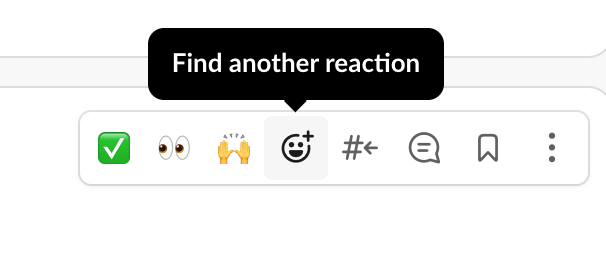
I may be generalizing here a bit, but I think “Thumbs up” and “Smiling face” are the two most commonly used emoji response in an office setup. Your team completed a task on time, here’s a thumbs up. You agree with a certain message, here’s a thumbs up. You wanna nod to a casual joke by a colleague, here’s a smiling face. But, in Slack, these 2 responses are buried inside the “Find another reaction” submenu. The ones available upfront are – “Completed”, “Taking a look”, “Nicely done”. I have never used them even once on any messaging platform in my entire life. 

Slack emoji response

Here is what I think Slack can do simplify the user experience –

  • Analyze the data across all the users and figure out the 3 most commonly used emoji and show them upfront. If “Completed”, “Taking a look”, “Nicely done” are indeed the top 3 used emojis across all Slack users then my bad and what the hell is wrong with you guys?
  • Customize it at the user level and show the user’s 3 most used emojis upfront. They are in fact doing it already, but it’s still buried inside the “Find another reaction” submenu. Just bring it outside so that I can use my favorite emojis with just one click.

8. The “Return to recent” fiasco

In their mobile app, clicking on a message in “@Mentions” takes me to the respective channel but I have to click on “Return to recent” if now I want to message on this channel. Really weird. Why can’t it just be a simple redirection to that channel with a focus on the concerned message?

9. No Tabs

Slack positions itself as an alternative to email. They even have a whole page dedicated on their website to explain why Slack is better than email? Although, I think they are way beyond email already. They are competing with WhatsApp, Skype/Teams, Google Hangout etc.

However, one thing where email still beats Slack user experience is the ability to have multiple tabs open simultaneously. It would really help if I can have multiple channels / DMs open at the same time so that I can refer them together rather than continuously switch from one channel to another. It may appear counter-productive at first but that’s just how people are. We all are productive in our own messy little ways. Again, we made a similar comment about Gmail not allowing us to open emails in a new tab in our Gmail UX review

Okay, enough ranting. There are also some things Slack is pretty good at. Salesforce didn’t pay all that money for nothing.

What works for Slack UX design?

1. Getting all the channel history on being added to a channel.

When someone gets added to a channel, they get access to all the previous messages in that channel as well. This is extremely useful in the workplace setup as people get added to conversations on a need basis and not always at the time of channel creation. Thus, it helps you get a proper context on the conversations. 

This is a big problem with WhatsApp groups where you get added to a group, but you have no context of the previous messages in that group.

2. Doesn’t eats up your phone storage

We get thousands of messages on Slack and since all of it is maintained in cloud, our phone storage is not consumed that much. This again is one of the biggest advantages Slack has over WhatsApp, which has now earned a lot of bad rep for eating up a significant chunk of your phone storage.

Now, we understand that WhatsApp stores all the messages in your device to make it secure and fast, but that leads to the above problems. And as a user I really don’t care about the tech implementation, this is a pain point and Slack does a better job at solving it.

3. Creating quick temporary group conversation

Often, we need to have a quick discussion with multiple people. Now, we shouldn’t use channels as this is supposed to be a temporary one-time conversation. Also, we can’t use DM as DMs are 1:1.

Creating such temp discussion groups in Slack is super easy. It’s as easy as typing names in the “To” list of an email. Though the same can be done in other platforms (like WhatsApp, Skype) as well, their UX is just not that great.

4. “Remind a message” feature

This is a really cool feature. I can set reminder to individual messages so that I can be reminded to act upon it. This can act as a mini calendar / to do list. However, the reminder comes as a message from Slackbot and we tend to ignore most of the messages from Slackbot. Still, something is better than nothing.

Slack reminder

5. Notification sound

The default “Knock Brush” notification sound in the Slack desktop client is just a user experience delight. It’s so unique and it just makes you want to check your messages instantly. I understand that it may just be a personal preference and others may not like it, but I am yet to meet anyone who is annoyed by that sound. 

Agree / Disagree with the above list? Have anything to add? Let us know your thoughts on the Slack user experience in the comments or through our social media.

How to explain Product Management to your parents?

Let’s be honest, as a product manager, you find yourself in a really tough spot when your friends and family ask you that dreaded question – “So, what does a product manager do?”. Heck, people within the tech domain also can’t properly explain what Product Management is and what does a product manager do? And a lot of times, product managers themselves can’t properly explain what they do (and thus, the high level of Impostor Syndrome among product managers). Over the years, I have (or at least I think I have) been able to successfully explain my job role to my mother. So here is my 2 cents to fellow product managers trying to explain their job to the world without feeling like a total con man.

Explain Product Management to Parents

P.S. Our assumption here is that we are dealing with someone who isn’t familiar with the know-how of the tech world. And thus, at times, some of the concepts below may seem too obvious to you but try to think of it from the perspective of a complete outsider.

Step 1 – The “short and simple” explanation

Don’t overload your family with complex Product Management concepts at the beginning itself. They won’t get it in the first attempt for sure. Don’t even think of bringing up that Venn diagram where Product manager sits at the intersection of business, design and technology. Just give them a simple and short explanation to build some credibility and comfort first. For me, during the initial few years, the go-to answer has been “I make Software”. I know that it is not entirely accurate as product managers don’t code but at the same time it is not completely false as well since product managers do help create software by defining what the software should do.

Next, sooner or later, you’ll be asked some variation of “But you don’t code. So how do you make software then?”. Time for step 2.

Step 2 – Explain how Software is made

Now, without getting into too many details, you just have to communicate the concept of how a software is made. I usually explain it as –

  1. There should be someone who can define what the software should do. For e.g. – should it help you buy stuff online, book a cab or watch a movie etc. These are the product managers. 
  2. There should be someone who can actually write the code to create the software as per the requirements defined above. These are the software engineers.

To make it simple, try to use an analogy with some other profession which is more relatable to them. I usually use one of the below 2 –

Making a movie

  • There are “Actors”, who act and are the face of the movie for most of the people. And then,
  • There are “Directors”, who decides the storyline, cast the actor, guides them and works with them to make sure that everyone plays their role to perfection.

A product manager is more like a “Director” for the software.

House Construction

  • There is an architect who designs the blueprint of a building – how many floors it should have, how many rooms should each floor have, size of each room, where should the kitchen be etc. etc. And then,
  • There are contractors who, along with their team, carries out the task of actually building the house as per the architect’s design. 

A product manager is more like an architect in this example.

Feel free to use any other profession if it helps your case.

Step 3 – Time for the details 

Now that you have briefly explained your role as a product manager, it’s time to get into the finer details of product management. Now you have to try and explain your product (aka Software) to your family. There is no set framework for this. However, it would really help your case if they have already used your product (or a competitor’s product) in some capacity. If not, then try to make them use your product if possible. Next, try and explain them –

  • Who are the users of your product?
  • What problem does your product solve?
  • Most importantly, how does your company make money (or plan to make money) through this product?

However, just try to keep things at a high level without getting into too many details. Remember, you are not trying to hire them for your team. You are just trying to explain your work life (which is at least one-third of your life) to them so that you both can connect better and have much more meaningful conversations. And believe you me, when you get to a state where you can freely talk about your work with your family, it brings a totally different level of satisfaction and peace of mind.

P.S. The above steps got the job done for me in the past. They are not guaranteed to work with every individual. However, it’s worth a shot.

Did you find this helpful? Is there some other approach that has worked for you to explain product management? Let us know in the comments or through our social media. 

8 User Experience (UX) design LinkedIn does wrong

With over 700 million users and monthly active users (MAU) of over 300 million, LinkedIn is one of the top social media platforms. In today’s world of social media overload, LinkedIn has been able to carve a unique niche for itself in the form of “networking for professionals”. However, LinkedIn’s user experience (UX) has not evolved much over the years and LinkedIn has been winning primarily because of lack of decent competition. If LinkedIn focus more on its UX game, will it be able to better tackle the growing competition from Indeed, Glassdoor and other similar platforms? Will it be able to drive more engagement and user growth? Let’s discuss the top 8 user experience (UX) design that LinkedIn does wrong.

User Experiene (UX) design
Continue reading

How to Write a PRD (Product Requirements Document): Examples & Template

If you’ve ever asked “how do I actually write a PRD?” and come away from Google with a list of six vague headings and no idea what to put under them, this guide is for you. I’ve written and reviewed PRDs for over a decade as a product manager, and I’ve watched dozens of the candidates I mentor freeze at exactly this point — they know a PRD needs an “objective” and “success criteria”, but they’ve never seen a real one filled in end to end.

So this isn’t another list of components. We’ll cover the six sections every PRD must have, and then I’ll write a complete worked example in front of you — a real PRD for a “save your card for faster checkout” feature — section by section. At the end you’ll get a copy-paste template you can start with today.

How to write a PRD (Product Requirements Document)

First, what a PRD actually is (and isn’t)

A Product Requirements Document (PRD), simply put, lists out all the features of a product in as much detail as possible. In the product management world, a PRD is nothing less than a Bible — it’s the Product, Design and Tech teams’ go-to document for anything related to the product.

A PRD is different from a Business Requirements Document (BRD) or Market Requirements Document (MRD). A BRD/MRD focuses on what the actual customer problem is, or what the business opportunity is — the “why”. A PRD focuses on the “what” and the “how”: what are we going to build, and how are we going to build it?

Here’s the thing people get wrong: there is no fixed, standard template for a PRD. Every product manager has their own style, and every company has its own flavour. What doesn’t change is the set of questions a good PRD has to answer. Those questions map to six key components — so let’s go through them, and then build one for real.

The 6 key components of a PRD

1. Objective

This section explains, at a high level, why we’re building this product, what customer problem it solves, and how it helps the business grow.

Not every product is meant to change the world or have org-level impact. Even a modest objective like “achieving competitive parity” is perfectly valid. The point of this section isn’t grandeur — it’s alignment. Every stakeholder should walk away agreeing on why this exists.

2. Success Criteria

Success criteria are the quantitative metrics you’ll use to judge whether the product succeeded or failed after launch. Be as specific as possible and leave nothing open to interpretation.

For example: if you’re revamping your sign-up flow to reduce user drop-off, your success criterion might be “a 10% drop in incomplete/abandoned sign-up requests”. You can define multiple metrics — as long as your system can actually measure them. A metric you can’t instrument is just a wish.

3. Product / Feature details

This is where the meat of the PRD sits. It lists the actual features and sub-tasks, usually written as user stories. The standard format:

As a [user type], I want to [perform some action] so that I [achieve some goal].

Say you want to store users’ credit card details on your e-commerce platform for faster checkouts. Your user story would look like:

As a buyer, I want to store my credit card details in my profile so that I don’t have to enter them every time and can check out faster.

That format is an industry standard, not scripture — adapt it to whatever your team understands best. The real job is clarity: Product, Design and Tech should read it and understand the requirement the same way.

Crucially, cover the corner cases. In the example above: What happens if the user enters card details but your system can’t verify them with the bank? Is there a character limit on the name field? Corner cases are where junior PMs get exposed and where real production bugs are born.

Beyond user stories, depending on complexity, this section should also carry: flowcharts / process-flow diagrams; implementation or tech-architecture notes where possible; assumptions made while building; constraints or known scenarios where the product won’t work; and prerequisites or dependencies on other data or products.

4. User Experience (UX) flows / Designs

Include a visual representation of the UX or user journey — wireframes, or low/high-fidelity prototypes. A picture really is worth a thousand words here. Seeing how the product will look to the end user solidifies the understanding you built in the previous section. Add competitor screenshots for reference if a similar feature already exists elsewhere.

As I wrote in Top 5 Product Management tools every PM must be good at: if your vision of the UX is all verbal, there’s going to be a significant gap between what you imagined and what the design team builds — leading to endless iterations and quietly eroding your credibility with the design team.

5. Roadmap / Release plan

A PRD should carry a tentative release timeline. For a complex product this usually means a phased release: a core set of features ships as the MVP (Minimum Viable Product), and the rest follow in later releases. This helps the tech team prioritise and allocate resources sensibly.

6. Stakeholder Review & Sign-off

This is one of the most important parts of a PRD, and it’s the one most often skipped — even at big MNCs. Review and sign-off brings accountability into the system. It forces stakeholders (Product, Business, Design, Tech) to commit to a defined scope, and ideally there’s no going back.

Product releases slip because the Product team expands scope mid-development, or the Business team quietly changes (or “forgets”) a requirement they’d agreed to, or the Tech team reworks the implementation to dodge complexity. It may not sound professional, but it’s the truth and you know it. As I put it in Top 10 Product Management Skills: tech is usually the easy part — people are the ones that bring the complexity. A signed-off PRD is your defence against all of it.

A full worked example: a PRD for “Save card for faster checkout”

Enough theory. Here’s what those six sections look like filled in for a real feature — letting returning buyers save a card so they can check out in one tap. This is deliberately concise; a real PRD would go deeper, but the shape is exactly this.

1. Objective

Returning buyers abandon checkout because re-entering full card details on every purchase is slow and painful, especially on mobile. We’ll let buyers securely save a card and reuse it for one-tap payment. The goal is to reduce checkout friction, lift repeat-purchase conversion, and stay at competitive parity with platforms that already offer saved cards.

2. Success Criteria

  • 10% reduction in checkout abandonment for returning users within 3 months of launch.
  • 20% of returning buyers save at least one card within 2 months.
  • +5% increase in repeat-purchase conversion rate.
  • No increase in payment-fraud or chargeback rate versus the pre-launch baseline.

3. Product / Feature details

User stories

  • As a returning buyer, I want to save my card during checkout so that my next purchase is faster.
  • As a buyer, I want to see my saved cards at checkout and pick one, so I don’t re-enter details.
  • As a buyer, I want to delete a saved card from my profile so that I stay in control of my data.

Corner cases

  • The card is saved but the bank fails to verify/tokenise it → don’t store it; show a clear error.
  • Saved card has since expired → flag it at checkout and prompt for a new one.
  • Buyer has multiple saved cards → mark one as default, allow switching.
  • Security → require CVV re-entry for each transaction even on saved cards.
  • Guest checkout → no save option is shown (no account to attach the card to).

Assumptions / constraints / dependencies

  • Assumption: card details are never stored on our servers — we store a token from the payment gateway (and, in India, comply with RBI card-tokenisation guidelines).
  • Constraint: only cards from supported networks/gateways can be saved in v1.
  • Dependency: the payment gateway must support tokenisation and return a reusable token.

4. UX flows / Designs

[Wireframe placeholder] Checkout screen shows a “Save this card for faster checkout” checkbox under the card form. Returning buyers see a “Saved cards” list at the top of the payment step with a “+ Use a new card” option. A “Manage cards” screen in the profile lets buyers view and delete saved cards. Attach the Figma link / screenshots here.

5. Roadmap / Release plan

  • MVP (Phase 1): save and reuse a single card, CVV required per transaction, delete from profile.
  • Phase 2: multiple saved cards, set a default, manage in profile.
  • Phase 3: true one-tap checkout, network tokenisation, saved UPI/wallet options.

6. Stakeholder Review & Sign-off

StakeholderRoleSign-off
ProductOwns scope & priorities
Business / PaymentsOwns conversion & commercial targets
DesignOwns UX flows & wireframes
EngineeringOwns implementation & tokenisation
Legal / ComplianceOwns RBI/PCI-DSS compliance

Once every box is ticked, scope is locked. Changes after this go through a documented change request — not a Slack message someone denies sending later.

Copy-paste PRD template

Start from this skeleton and delete what you don’t need:

# PRD: [Feature name]
Author: [name]  |  Status: [Draft / In review / Signed-off]  |  Last updated: [date]

## 1. Objective
- Problem:
- Why now / business goal:

## 2. Success Criteria
- Metric 1 (target, timeframe):
- Metric 2:
- Guardrail metric (must NOT get worse):

## 3. Product / Feature details
### User stories
- As a [user], I want to [action] so that [goal].
### Corner cases
-
### Assumptions / Constraints / Dependencies
-

## 4. UX flows / Designs
- [Link to Figma / wireframes / screenshots]

## 5. Roadmap / Release plan
- MVP:
- Phase 2:
- Phase 3:

## 6. Stakeholder review & sign-off
- Product / Business / Design / Tech / Legal → [sign-off status]

How to actually write it (a practical order)

Most PMs write a PRD top to bottom and get stuck. I write it in this order instead: nail the objective and success criteria first (if you can’t state the metric, you’re not ready to build), then draft user stories with the corner cases, then loop in Design for the UX flows, then set the roadmap with Engineering, and only then send it for sign-off. Writing it in that sequence means every section is informed by the one before it — and you stop rewriting the same doc five times.

Common mistakes I see

  • No measurable success criteria — “improve the experience” is not a metric.
  • Skipping corner cases — this is what separates a PRD that ships clean from one that spawns a bug backlog.
  • No sign-off — the single biggest cause of scope creep and delayed releases.
  • Writing for yourself, not the reader — if Tech and Design can’t act on it without a meeting, it’s a diary entry, not a PRD.

FAQ

What is a PRD?

A Product Requirements Document is the document a product manager uses to define what a product or feature should do and how it should behave, so Product, Design and Engineering are aligned before building.

PRD vs BRD vs MRD — what’s the difference?

A BRD/MRD covers the why (the business or market problem). A PRD covers the what and how (what we’ll build and how it should work).

How long should a PRD be?

As long as it needs to be and no longer. A small feature might be one page; a complex product several. Clarity beats length — if a section isn’t helping Design or Tech act, cut it.

Who writes the PRD?

The product manager owns and writes it, but it’s built collaboratively — Design shapes the UX section, Engineering the feasibility and roadmap.

Do PRDs still matter in agile?

Yes. Agile changed how often you revise the doc, not whether you need shared, written clarity. A lightweight living PRD beats tribal knowledge every time.

What tools should I use to write a PRD?

Whatever your team already lives in — Confluence, Notion, Google Docs. More on this in Top 5 Product Management tools every PM must be good at.


Preparing for PM interviews? Writing a crisp PRD is a common interview exercise. I’ve mentored 50+ candidates into roles at Google, Microsoft and Amazon — book a 1:1 mock interview session and we’ll practise it live.

Top 10 Product Management Skills

What does it take to be a good Product Manager? This is a question that has troubled mankind for decades(maybe). Product Management as a domain is still evolving and is one of the few domains which has not yet been transformed into an exact science. You think of ‘Marketing’ and immediately Philip Kotler’s name comes to mind as a marketing leader. Investment enthusiasts have got a great deal to learn from Warren Buffett and his investment principles. Core tech world has got their Bill Gates, Elon Musk, Mark Zuckerberg etc. But when it comes to Product Management, there is no general consensus on a ‘leader’ of the domain. And thus, there are no role models / benchmarks for aspiring Product Managers to follow and learn from. So, let’s discuss the top 10 Product Management skills that every Product Manager must be good at (in no specific order).

Skils
Continue reading